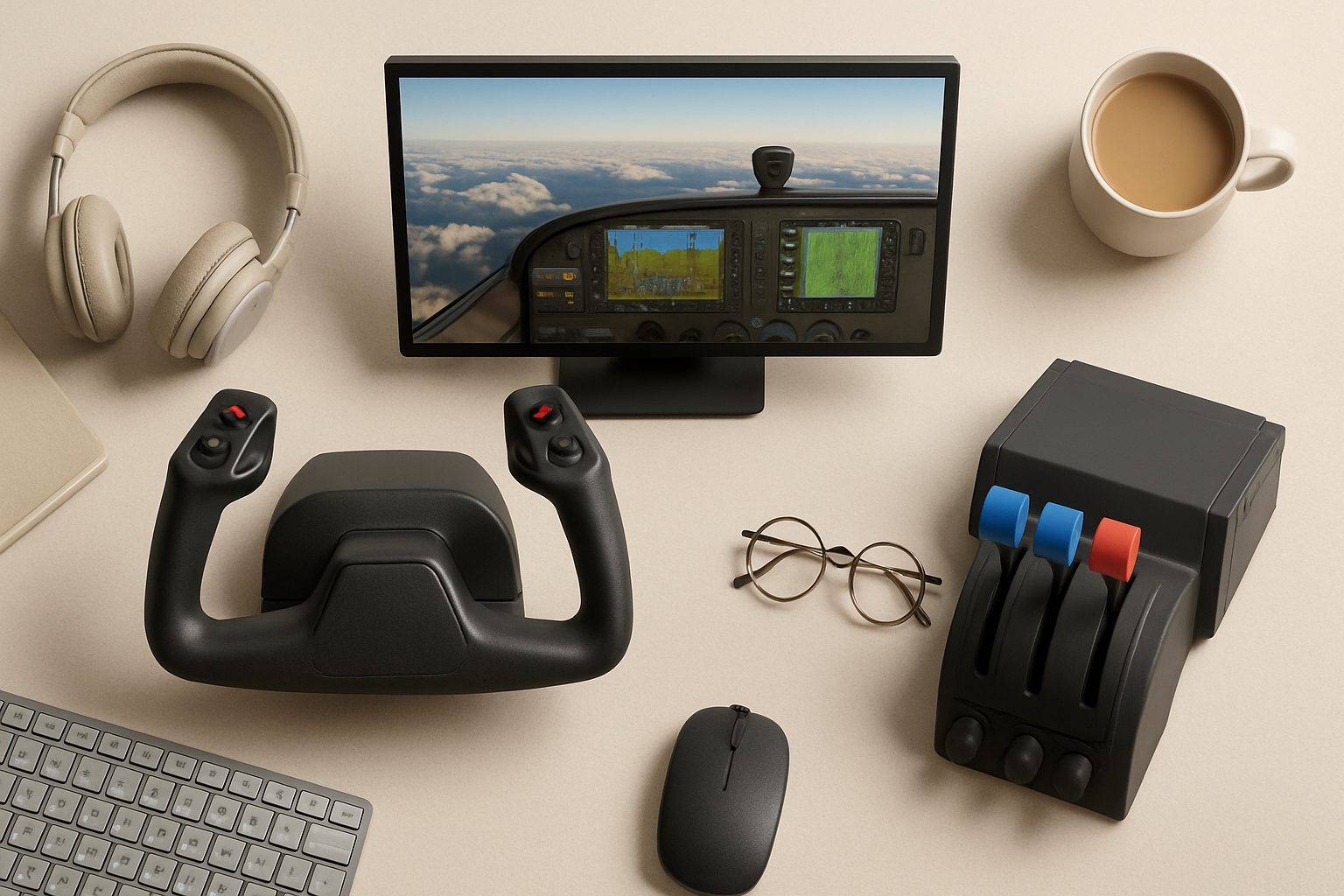
Best VR Headsets for Home Flight Simulation UK 2025
Flying a Boeing 737 into storm clouds whilst standing in your living room sounds like a fever dream, yet it's precisely what thousands of UK flight-sim enthusiasts do every week. Virtual reality transforms flight simulation from something you watch on a monitor into something you inhabit. But VR headsets aren't interchangeable; the wrong one will leave you squinting at instrument panels and feeling sick after 20 minutes.
This guide covers the headsets that actually work well for serious flight simulation, with specific focus on resolution, field of view, comfort during long sessions, and compatibility with Microsoft Flight Simulator 2024 and X-Plane 12.
Meta Quest 3: Best Value
The Quest 3 sits at a sweet spot for newcomers and budget-conscious simmers. It's standalone, so you don't need a gaming PC tethered to your face via cable, yet it connects to PC via Air Link or USB-C for serious simulation work.
Resolution is 1832 × 1920 per eye. That's adequate for reading most instrument text without squinting, though fine print on altimeters and transponders requires you to look directly at them. The 110-degree field of view is wide enough to feel immersive without peripheral tunnel vision.
Where it excels: the price (around £400-500 in the UK), the wireless connection option via Air Link, and reasonable comfort with the standard strap. MSFS 2024 runs smoothly on a mid-range gaming PC. The built-in hand tracking is irrelevant for flight sim but the controllers work fine with stick-and-throttle setups.
Where it disappoints: you're tethered to Meta's ecosystem, the optics have some chromatic aberration at screen edges, and refresh rates top out at 120Hz. Some users report slight motion sickness after extended sessions, partly due to the 90Hz default in some flight sim configurations.
HP Reverb G2: The Serious Choice
The Reverb G2 is the plane to upgrade to if the Quest 3 proves limiting. It's a tethered PC headset with 2160 × 2160 per eye—nearly double the Quest 3's pixel density.
Flying with the G2 feels sharper. You'll read instrument panels without head turning, and the vastly superior visual clarity makes spot-landing in fog far more intuitive. The 114-degree FOV is marginally wider than the Quest 3. Refresh rates reach 90Hz, though most simmers lock to 72Hz for frame consistency with variable CPU loads.
The Reverb G2 hits its stride with proper flight-sim setup: a yoke-and-throttle stack, pedals, and ideally a gaming PC with an RTX 4070 or better. Windows Mixed Reality backend means Windows integration is seamless and Microsoft Flight Simulator feels like it was designed for this headset—which, frankly, it was.
Comfort is solid. The strap is adjustable, the lenses sit at a proper distance, and extended sessions (3-4 hours) remain tolerable. Some users report eye strain if the headset isn't positioned perfectly, but that's true of any tethered device.
The catch: you're looking at £700-900 for a used or refurbished unit in the UK market (new stock is scarce). You need a decent PC. And you're accepting a cable, which means your play space is bounded.
Pimax 12K SE: High-End Alternative
Pimax targets enthusiasts willing to spend. The 12K SE boasts 3840 × 2160 per eye and a massive 170-degree field of view.
The extreme FOV transforms flight simulation. Peripheral vision suddenly works—you see wing-mounted tanks and engines without turning your head, which mirrors real pilot vision far better than 110-degree headsets. The resolution is spectacular: every switch label, every gauge marking, is crisp.
It's pricey (£1500+) and demanding. You need a high-end PC (RTX 4080 or better) to maintain 60fps with visual fidelity. The headset is heavy compared to competitors, and some users find the weight tiring over long flights. Pimax's Windows Mixed Reality implementation is functional but less polished than HP's.
For casual simmers, it's overkill. For pilots wanting to replicate real-world scanning and instrument visibility, it's compelling.
Key Considerations for Flight Sim
Resolution matters more than frame rate. Flight simulators are mostly static—you're staring at a cockpit. A crisp 72Hz image beats a blurry 120Hz one. Aim for at least 1832×1920 per eye.
Field of view affects immersion. Anything below 100 degrees feels claustrophobic in a cockpit. 110-120 degrees is adequate; 170 degrees is genuinely different.
Comfort is non-negotiable. A two-hour flight should feel pleasant, not an endurance test. Test headsets beforehand if possible. Weight, strap design, and lens-to-eye distance all matter.
Stuttering ruins immersion. Match your PC power to your headset. An underpowered system makes flight sim unusable. Budget for a PC upgrade alongside your headset purchase.
MSFS 2024 and X-Plane 12 Compatibility
Both major simulators work with all three headsets. MSFS 2024 integrates directly with Windows Mixed Reality (Reverb G2 advantage) and supports OpenXR broadly (Meta Quest 3 via Air Link, Pimax via USB). X-Plane 12's VR implementation is engine-native and stable across platforms, though performance varies by aircraft complexity.
Neither simulator perfectly exploits ultra-high resolution—they're CPU-bottlenecked before GPU limits kick in. Upgrading from the Quest 3 to the Reverb G2 won't automatically net you smoother framerates; CPU headroom matters most.
Conclusion
Start with the Meta Quest 3 if you're testing the waters. Its price, wireless option, and performance floor make it forgiving. Step up to the HP Reverb G2 if you're serious about instrument clarity and have the PC to back it. Consider the Pimax 12K SE if peripheral vision and cockpit immersion justify the investment and weight.
Whichever you choose, budget for additional investment in a yoke-and-throttle, a sturdy chair, and ideally rudder pedals. The headset is only one piece of the setup. Get it right, though, and you'll be navigating UK airspace with perspective that monitor-based flying simply cannot match.
More options
- Honeycomb Alpha Flight Controls Yoke (Amazon UK)
- Thrustmaster TCA Officer Pack Airbus Edition (Amazon UK)
- Logitech G Pro Flight Rudder Pedals (Amazon UK)
- Meta Quest 3 VR Headset (Amazon UK)
- Honeycomb Bravo Throttle Quadrant (Amazon UK)