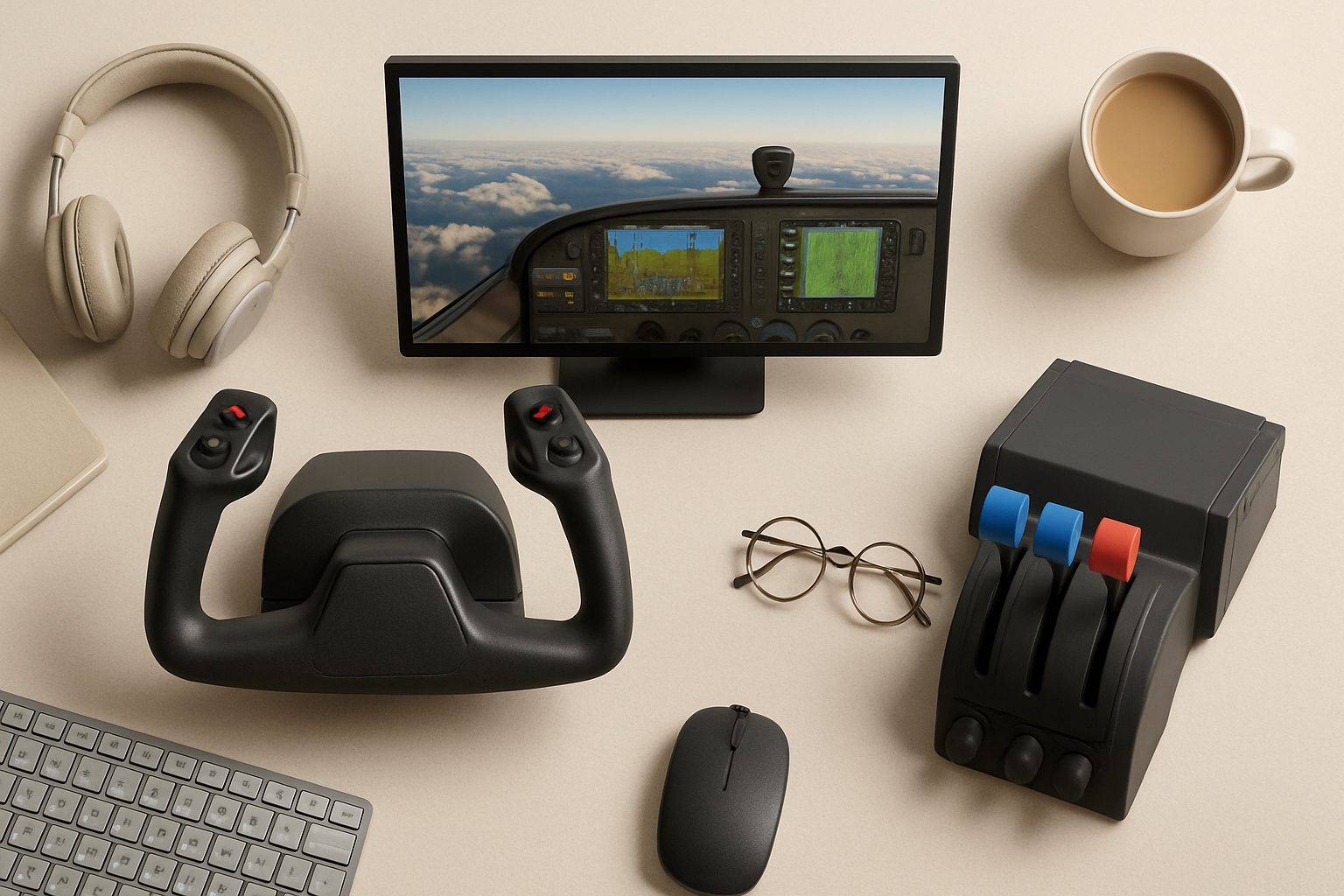
Full Motion Flight Simulator Platforms for Home Use UK: What Do They Cost?
Motion platforms transform flight simulation from a stationary experience into something genuinely immersive. Rather than watching your aircraft pitch and roll on a screen, you feel the movement — your seat tilts into climbs, heaves during landings, and shudders through turbulence. For serious simmers, it's the next logical investment after a decent stick and throttle setup. The catch: they're expensive, they need significant space, and the UK pricing is often steeper than US equivalents due to import costs and VAT.
Entry-Level Motion Platforms: £8,000–£15,000
The most accessible option for home simmers is a budget motion platform like the Easyrig or basic 3DOF (three degrees of freedom) systems. These give you pitch, roll, and yaw — the core movements your inner ear actually registers. A simple three-axis rig, often assembled from readily available parts and frame kits, sits in the £8,000–£12,000 range landed in the UK.
What you actually get: your entire seat platform moves on motorised actuators. It's genuinely effective. During a stall, you'll feel the nose dropping. On crosswind landings, the roll is unmistakable. Most home builders source kits from suppliers and add their own cockpit frame and electronics. The motion feels real because it's real — there's nothing synthetic about it.
The limitation is subtle but important: a 3DOF platform can't simulate lateral G-forces (side-to-side acceleration), which you do experience in banking turns. It compensates reasonably well by tilting the seat, but it's not identical to actual flight. Still, for £10,000, it's a genuine step up from static.
Mid-Range: Next Level Racing Motion Platforms (£15,000–£22,000)
Next Level Racing makes motion platforms primarily for sim racing, but they absolutely work for flight sim. Their DirectForce Pro systems start around £16,000–£18,000 in the UK and scale upward. These are fully integrated rigs with integrated cockpit frames, quality-spec actuators, and proven electronics. You're paying for polish and customer support.
These platforms are engineered and tested. They work reliably over years. Your rig won't fail mid-descent because a connection came loose. NLR platforms also integrate well with Microsoft Flight Simulator, which handles motion data directly — you simply plug into their motion API and it works.
The catch: NLR rigs are optimised for racing G-forces, which differ from flight forces. They still work for flight sim, and many dedicated simmers do use them, but you're adapting a racing platform rather than flying with a purpose-built system.
Premium Option: DOF Reality (£20,000–£35,000)
DOF Reality, a German company, builds fully bespoke 6DOF platforms—that's three linear axes (up-down, left-right, forward-back) plus three rotational axes (pitch, roll, yaw). This covers the full spectrum of motion your body perceives. Their units are modular and scalable, starting around £22,000–£25,000 for UK delivery and climbing significantly for larger setups.
A 6DOF platform is the simulator equivalent of a real flight experience. Lateral acceleration during turns is genuine motion, not just seat tilt. Vertical G-forces during climb-outs register properly. You're not fighting the physics — you're experiencing them.
DOF Reality platforms have strong integration with MSFS 2024 and X-Plane, though setup requires more technical knowledge. They're also more demanding on your PC (you'll need a GPU capable of sustained 120+ fps) and your electrical supply (240V connection recommended).
Bespoke and DIY Rigs (£6,000–£30,000+)
The UK has a small but skilled community of DIY builders. Custom rigs range wildly: some are brilliant, some are fragile. Budget for a self-sourced 3DOF or 4DOF platform is £6,000–£12,000 if you're handy and patient. If you hire someone to build it, add £5,000–£10,000 in labour.
The advantage is flexibility—you can optimise for your specific cockpit layout, budget, and space. The risk is that a poorly engineered rig can be unsafe or unreliable.
Space Reality Check
Here's what nobody mentions until you've bought: motion platforms are massive. A typical 6DOF rig occupies a footprint of roughly 2.5 m × 2 m and stands 2.2 m tall. A 3DOF might be slightly smaller but still needs generous clearance. You can't put it in a bedroom cupboard. Most simmers dedicate a garage corner or spare room, and even then it's the dominant fixture.
Budget an additional 2–3 square metres of clear space around the rig for maintenance and safe operation.
MSFS 2024 Compatibility
Microsoft Flight Simulator's motion API works with any platform that can output standard motion data formats. NLR rigs are plug-and-play. DOF Reality requires configuration. DIY rigs need custom software, often using tools like SimXperience or Motion Lounge to translate sim outputs into actuator commands.
The reality: MSFS compatibility is solved. Pick your platform, and motion will work. The question is how smoothly.
The Real Cost Question
Price alone doesn't tell you much. A £10,000 3DOF rig that's reliable and well-built is better than a £20,000 custom platform that fails. Equally, a 6DOF system's immersion advantage scales with your budget for a quality cockpit chair, peripherals, and display setup.
Most simmers say motion platforms are worth the investment if you're already deep in flight sim (hundreds of flight hours logged, quality stick and throttle in place). If you're still finding your way, a good static setup goes further.
More options
- Honeycomb Alpha Flight Controls Yoke (Amazon UK)
- Thrustmaster TCA Officer Pack Airbus Edition (Amazon UK)
- Logitech G Pro Flight Rudder Pedals (Amazon UK)
- Meta Quest 3 VR Headset (Amazon UK)
- Honeycomb Bravo Throttle Quadrant (Amazon UK)